
Navegante
A Rails control plane that turns connected repositories into provisioned, deployed, observable applications and managed services.
Hostari Labs founders Xavi Ablaza and Richard Parayno built Navegante.
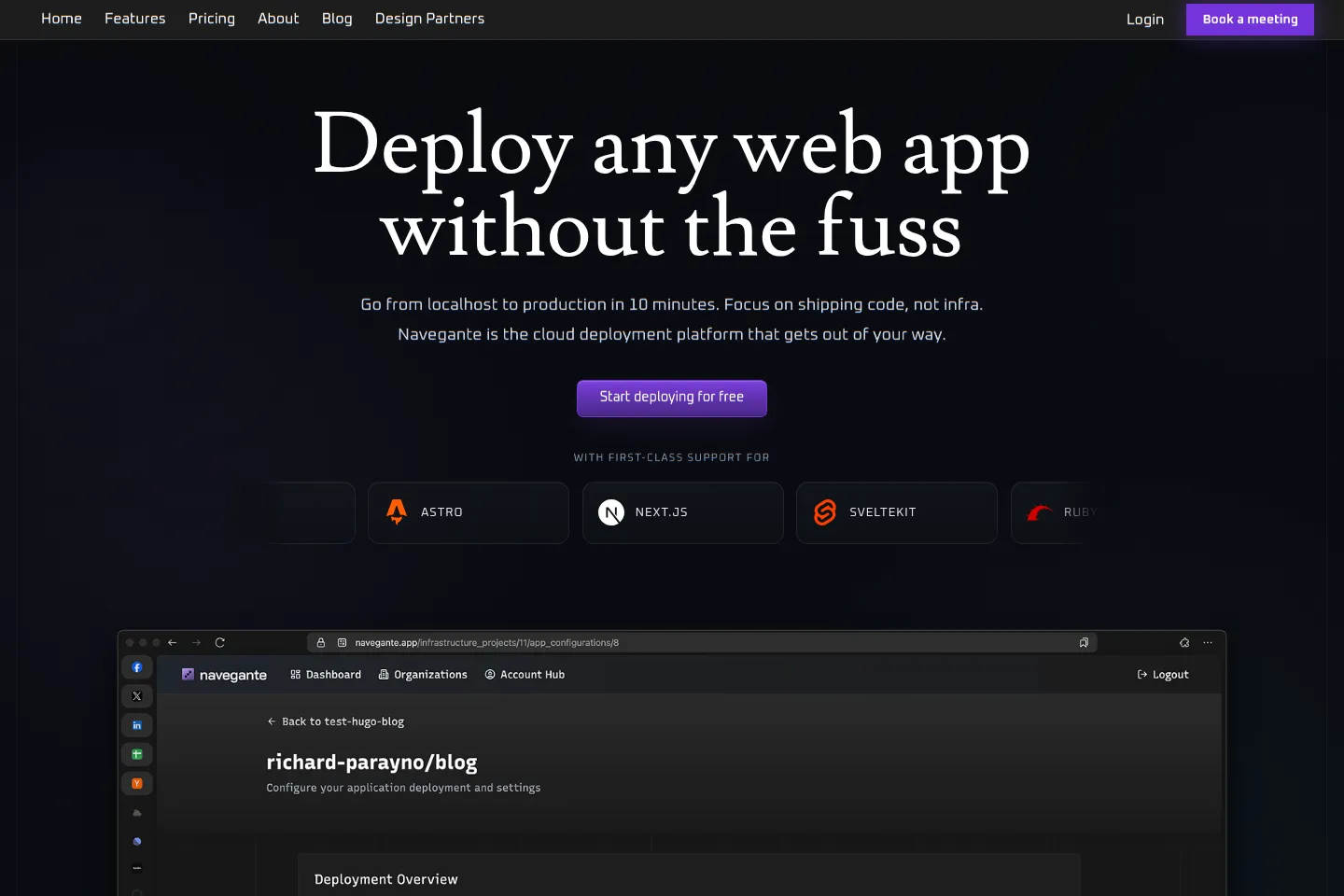
Navegante brings repository context, infrastructure provisioning, deployment orchestration, health, logs, and managed data services into one production workflow for software teams.
The product problem
Application teams can ship code quickly and still lose days assembling the operating layer around it: compute, networking, DNS, deploy tooling, secrets, databases, logs, health checks, recovery, and billing. Navegante treats those concerns as one product workflow instead of a pile of disconnected infrastructure tasks.
Repository to running service
A connected GitHub repository becomes an infrastructure project with application configuration and auditable deployment attempts. Teams can deploy source repositories or Docker Compose workloads, configure build and runtime values, attach custom domains, and create branch previews without maintaining a separate deployment system.
On first deploy, the Rails control plane selects capacity, allocates and configures a Proxmox VM, prepares networking, and records the resulting infrastructure. Deployment jobs then fetch source, generate Kamal configuration, and dispatch work to dedicated builders through Redis. Resource locks serialize changes to the same application while background workers monitor completion, redact and persist logs, classify failures, and apply bounded recovery paths.
Health is separate from release status
A successful deployment is not the same as a healthy application. Navegante models deployment state and runtime reachability independently. Scheduled HTTP checks record target, response time, status, and failure category, requiring repeated failures before an application is marked unreachable. Grafana, Prometheus, Loki, and Alloy connect application logs and resource data back to the customer experience.
Managed services in the same control plane
The operating layer also provisions managed PostgreSQL. Standalone databases reserve infrastructure capacity, generate credentials, assign stable internal DNS, and route connections through datacenter proxies. Clustered workflows model primary and replica nodes, Patroni, redundant proxies, a floating writer address, backups, restores, and failover-oriented smoke tests.
What the work demonstrates
Navegante is platform-team leverage packaged as software: Rails and Solid Queue for orchestration, Proxmox for infrastructure, a Hostari fork of Kamal for delivery, GitHub and Cloudflare integrations, Stripe for subscription lifecycle, and production telemetry built into the workflow from day one.
What could your organization move faster on?
Tell us about the product, workflow, or software initiative that needs to move from idea to production.