
Hostari
Expanding a successful single-game workflow into a shared platform for dozens of game-server products and self-service virtual private servers.
Hostari Labs founders Xavi Ablaza and Richard Parayno built and operate Hostari.
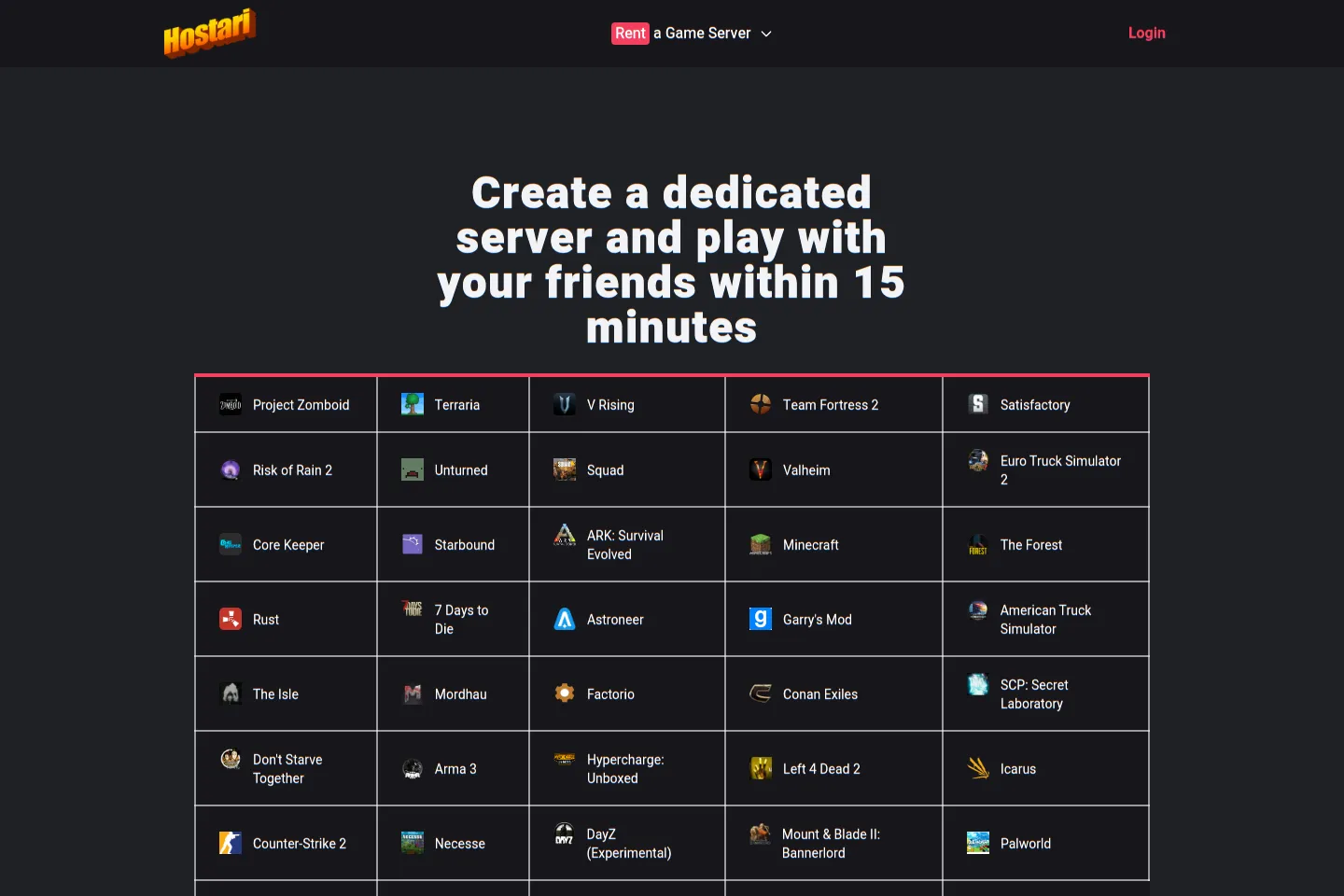
Hostari unified product catalog, provisioning, billing, infrastructure operations, customer controls, monitoring, and support across game servers and VPS workloads.
From one game to a product family
ValheimServerHosting proved that players valued a managed experience over raw compute. Hostari generalized the operating model so the team could launch many games and VPS plans without rebuilding provisioning, billing, and customer operations for every offer.
A shared game-server core
The Crystal and Lucky GamesSite application models common concepts—games, plans, regions, dedicated hosts, allocations, subscriptions, backups, credentials, and shell playbooks—alongside game-specific server and world records. Sign-up pages cover a broad catalog, while a code generator creates the model, query, operation, action, page, and migration skeleton needed to add another game consistently.
Workers and services translate subscriptions into server creation, configure confined system users, execute approved playbooks, track status, manage cancellations and reactivations, and surface Stripe webhook delivery issues. Game-specific control paths remain available for world files, maps, admins, bans, and configuration instead of forcing every workload into the lowest common denominator.
Self-service VPS provisioning
A separate Next.js and TypeScript application powers the Hostari storefront and VPS dashboard. Supabase manages application data and authentication, Stripe handles checkout and billing portals, and a typed Proxmox integration creates and configures VMs. Customers can choose plans and operating systems, provision a server, manage public SSH keys, inspect credentials securely, and run power actions from the dashboard.
The implementation includes server-state hooks and realtime updates, operating-system-specific setup paths, encrypted secrets, Honeybadger monitoring, and integrations for support and transactional communication.
What the work demonstrates
Hostari is a platform assembled around two durable abstractions: a shared operational core for repeatable products and explicit workload-specific edges where users need deeper control. That balance allowed the business to move from one hosted game into a wider game catalog and VPS offering while retaining a consistent production workflow.
What could your organization move faster on?
Tell us about the product, workflow, or software initiative that needs to move from idea to production.