
Valheim Server Hosting
Turning dedicated game servers into a five-minute, self-service customer workflow with automated provisioning, billing, support, and mod operations.
Hostari Labs founders Xavi Ablaza and Richard Parayno built ValheimServerHosting.
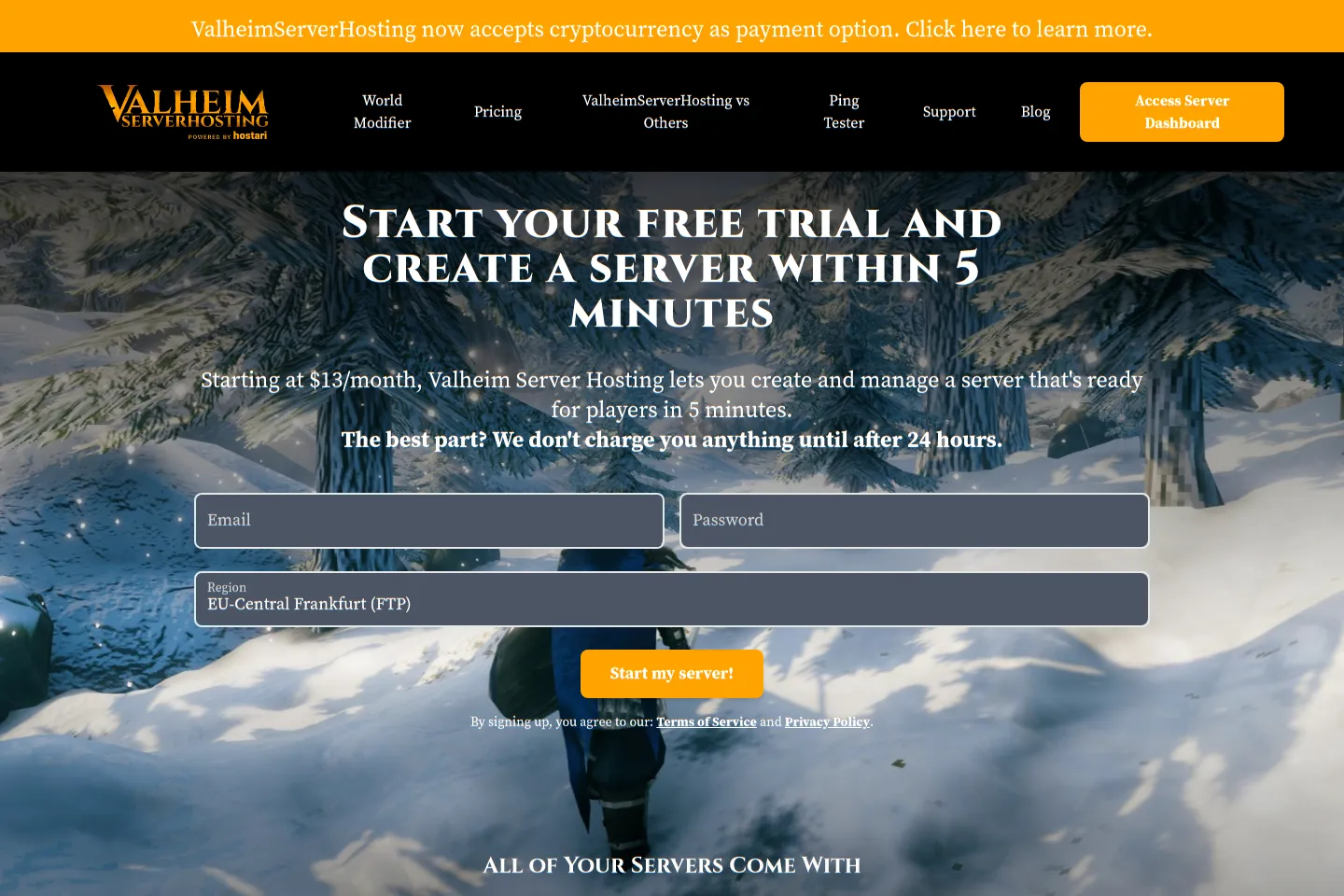
ValheimServerHosting.com packaged infrastructure work that normally required command-line access and server administration into a product players could start, operate, and extend themselves.
The challenge
Running a reliable Valheim world combines host placement, installation, ports, credentials, backups, game updates, access control, mods, billing, and support. The product opportunity was to hide that operational complexity without hiding the controls that matter to players.
The five-minute workflow
The customer journey was organized around time-to-first-server: choose a region, create an account, configure a world, and receive a playable server in minutes. A Crystal and Lucky application connected signup and Stripe lifecycle events to dedicated-host capacity, port allocation, setup records, and server status.
The control panel exposed player and administrator management, bans, billing, world upload and creation, configuration, restart and recovery, while background workers handled status polling, game-version updates, scheduled backups, subscription changes, expiry, reactivation, and stuck-server recovery.
Mods as an operated product
Mod support was built as a workflow rather than a file upload box. The system synchronized Thunderstore packages and versions, tracked files installed on each server, managed BepInEx and Valheim Plus configuration, and provided guided install, uninstall, confirmation, and reboot paths. Hash extraction and version workers gave the team evidence to reconcile server state with catalog state.
Production feedback loops
The application included event tracking, conversion ETL, experiments, support segmentation, and operational parity checks. This connected product questions—such as where signup stalled—to the same system that understood provisioning and fleet state.
What the work demonstrates
This is vertical SaaS built from operations outward. The differentiator was not only a storefront; it was the production system joining demand, payment, infrastructure capacity, automation, game-specific state, and human support.
What could your organization move faster on?
Tell us about the product, workflow, or software initiative that needs to move from idea to production.